

Workforce Index—May 2026: A Mixed Picture
This month’s Workforce Index brings a full data refresh across the board—unemployment, hiring, wages, layoffs, and cost of living are all current. The headline: King County’s unemployment rate fell back below 5% for the first time since late 2025, but a shrinking labor force complicates the story. Meanwhile, healthcare employers are surging, job openings continue to climb, and WARN-reported layoffs are tracking ahead of recent years.
Here’s what stood out in the May update.
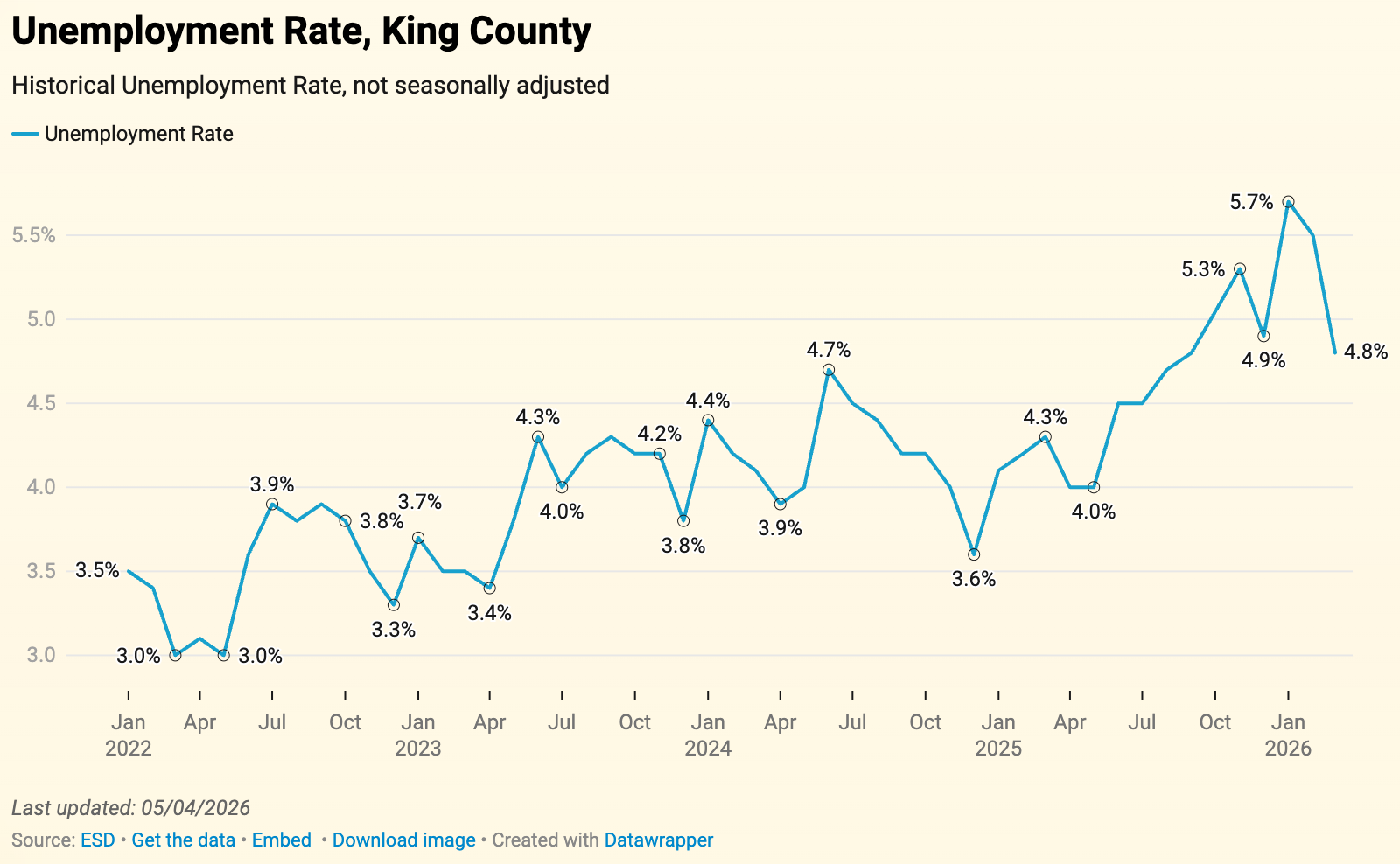
Unemployment fell to 4.8%—but the story is complicated
King County’s unemployment rate dropped sharply from 5.7% in January to 4.8% in March 2026, the first time below 5% since late 2025. But the decline was driven in part by a shrinking labor force, which fell by roughly 13,000 between February and March—meaning some workers stepped away from active job-seeking rather than finding employment.
The rate improvement is real, but it doesn’t reflect a straightforward jobs recovery. Whether the region is settling into a higher unemployment baseline or returning to tighter conditions will become clearer as spring and summer data come in.
Healthcare hiring is surging as tech and aerospace pull back
This month’s “biggest mover” in employer hiring volume is Providence, with unique job postings up 60.7%. They’re not alone—Soliant Health (+47.1%), Swedish Health Services (+32.5%), and Seattle Children’s Hospital (+30.8%) all posted significant increases. Meanwhile, several of the region’s largest tech and aerospace employers cut back on postings: Microsoft (−46.5%), Boeing (−31.8%), Google (−23.7%), and Blue Origin (−21.4%). The shift highlights a changing mix in regional hiring demand, even as overall posting volume remains concentrated among large employers.
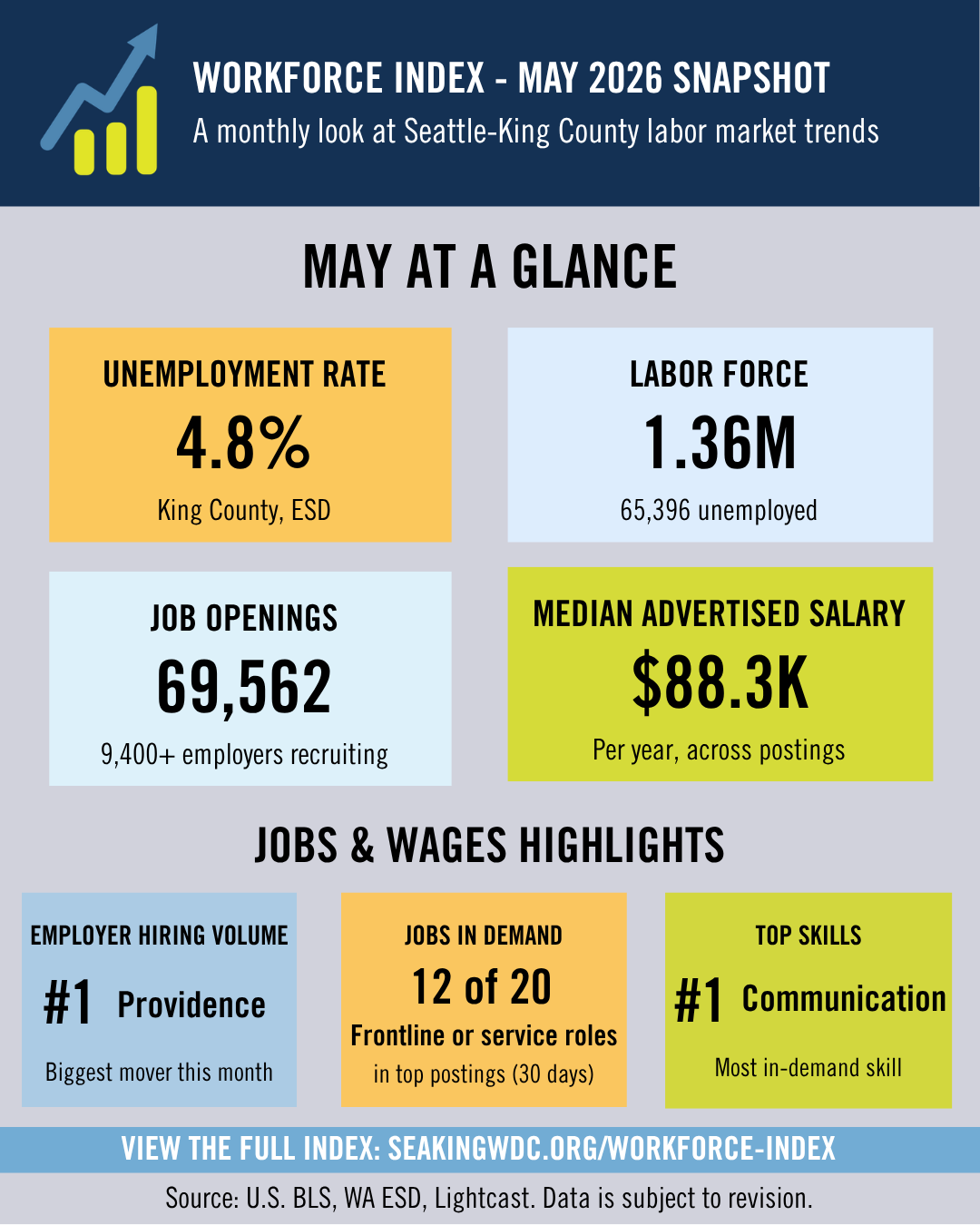
Job openings climbed past 69K, but wages dipped
Employers posted 69,562 job openings between March and April 2026—up from 65,970 in the prior period—with 9,421 unique employers competing for talent. However, median advertised salary slipped to $88,320 per year, falling back below the $90K threshold it had just crossed. The growth in volume alongside the wage dip may reflect a shift in the types of roles being posted rather than a broad pullback in compensation.
Frontline and service roles dominate the most-posted titles
Software-related titles still lead King County’s most-posted job titles by volume, but 12 of the top 20 roles—or 60%—fall in frontline or service occupations like baristas, medical assistants, CDL truck drivers, and warehouse associates. Within the top 20, the fastest-growing roles include Data Engineers (+50.9%), Executive Assistants (+33.3%), and Medical Assistants (+22.0%), while Registered Nurses (−41.0%), CDL Truck Drivers (−25.8%), and Software Engineers (−22.1%) all posted notable declines. The overall picture suggests a labor market in transition—still active, but shifting in where and how demand is showing up.
Foundational skills still dominate, even as AI grows fastest
Even as artificial intelligence has emerged as the fastest-growing skill in employer postings, the most in-demand skills in King County’s labor market remain decidedly foundational. Communication appears in more job postings than any other skill—183,631 over the past year, by a significant margin—followed by Customer Service, Management, and Operations. These competencies show up across industries, role levels, and salary ranges, reflecting the baseline expectations employers bring to nearly every hire.
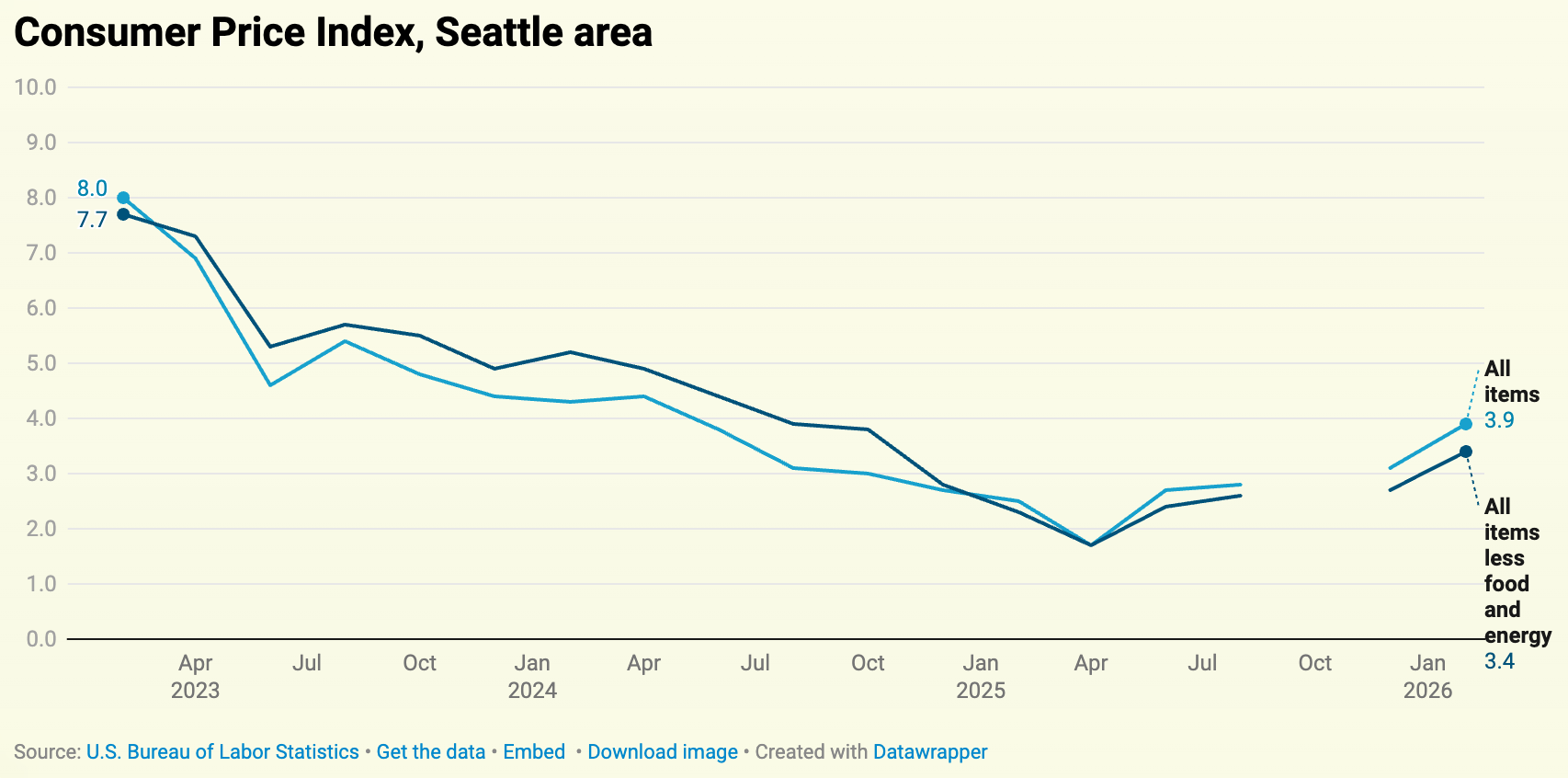
Inflation ticked up to 3.9% in the Seattle area
The Consumer Price Index for the Seattle area rose to 3.9% as of February 2026, reflecting a continued uptick from the lows seen in mid-2024. Excluding food and energy, prices rose 3.4%—suggesting broad-based price pressure rather than volatility in any single category. While inflation remains well below the peaks seen in 2022, the recent upward trend means cost pressures are still a reality for many Seattle-area households.
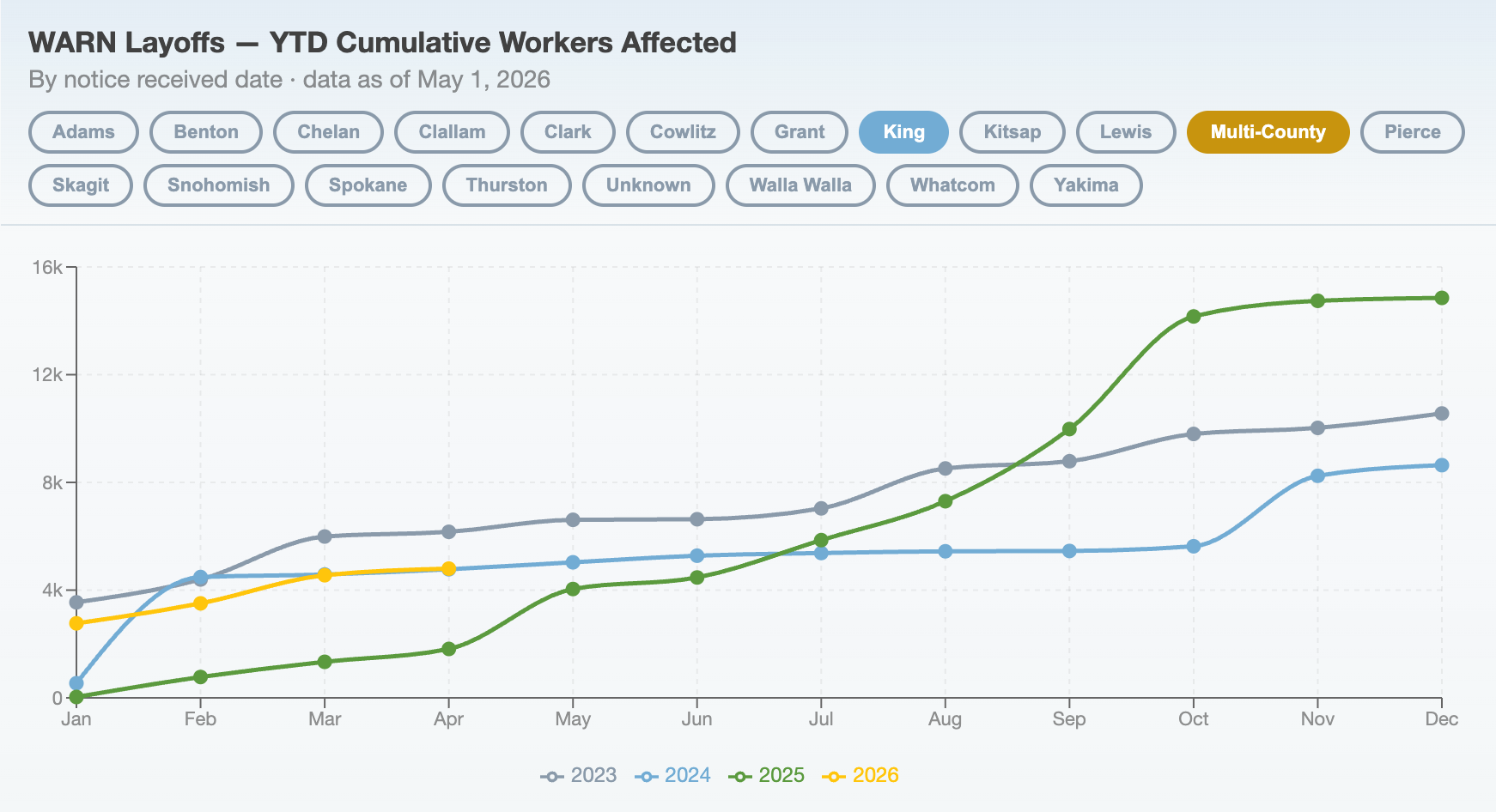
WARN layoffs are tracking ahead of recent years
Through April 2026, 4,798 workers have been affected by WARN-reported layoffs—a pace currently outpacing both 2024 and 2025 at the same point in the year. 2025 ended with 14,850 workers affected, a 72% increase over 2024 and well above the 10,561 reported in 2023. The Information sector remained the largest source of layoff activity across all years, with Accommodation and Food Services and Retail Trade also seeing notable increases in 2025. WARN data is typically reported on a delay, and we’ll continue tracking how these shifts appear in the official data over the months ahead.
Explore the full data and filters in the Workforce Index. The Index pulls from public sources including the U.S. Bureau of Labor Statistics, Washington State Employment Security Department, and Lightcast.
Sign up for monthly updates to get the next snapshot delivered to your inbox.