

For many job seekers, a union grocery job is one of the best-kept secrets in Seattle-King County's labor market—stable hours, real benefits, and a clear ladder up to skilled, well-paying roles like meatcutter and fishmonger. But without industry connections or a formal credential, getting a foot in the door has often been the hardest part.
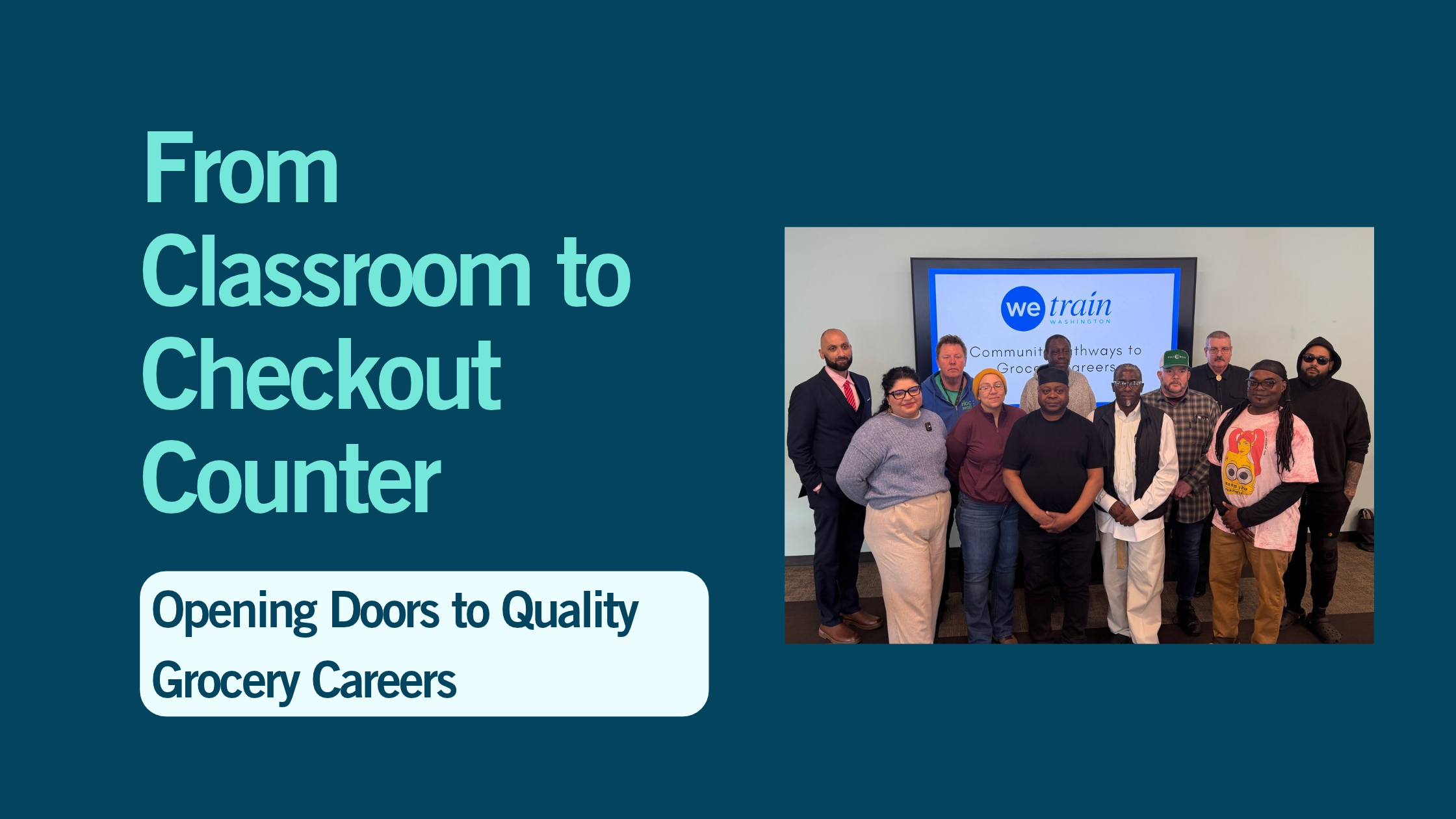
That's the gap WeTrain Washington set out to close with Community Pathways to Grocery Careers (CPGC), a Sound Jobs program supported by the U.S. Department of Labor's Critical Sectors Job Quality Grant. CPGC's model is simple in concept and rigorous in practice: in partnership with local community-based organizations, the program recruits job seekers into an intensive two-week, 40-hour bootcamp where participants earn a food handler’s certification and build not just technical skills, but a real understanding of grocery industry culture, professional expectations, and where a union grocery job can lead.
What sets CPGC apart is what happens during those two weeks. Relationships with employers aren't just an outcome afterthought—they're integrated into the training itself through site visits, guest instruction, and direct relationships with hiring managers at stores like QFC, PCC, and Safeway.
A Cohort, a Binder, and Two New Hires
CPGC’s October 2025 cohort put that philosophy to the test.
In earlier cohorts, participants typically waited until graduation to start job hunting, often facing weeks of searching before landing a position. WeTrain's training manager, Vanessa Gardner, decided to try something different. For the October cohort, participants began applying for jobs during their very first week of training.
When one participant, Asia, got a callback for an interview at a local Safeway, Gardner didn't just prep her for it. She went with her. While there, Gardner noticed something easy to overlook: a binder with information on multiple open positions. She documented and shared what she found with the whole cohort that same day.
Another participant, Heland, saw the listing and applied for a position at that same store. Within weeks, both Asia and Heland were hired at Safeway—a dramatically faster path to employment than the program had seen before.
“That cohort taught us something crucial,” Gardner said. “We don't have to wait until graduation to connect participants with employers. When we brought opportunities directly to people while they were still in training, we saw immediate results. Asia and Heland's placements weren't lucky breaks. They were the result of intentional design, and we've built that approach into how we run CPGC now.”
Iterating the Program Based on the Data
At the halfway point of the grant cycle, CPGC has trained 50 participants across three cohorts. 45 of them graduated, making for a 90% graduation rate. 10 graduates from the program’s general and English language learner (ELL) cohorts have been placed in quality jobs that start around $18-22 an hour with full benefits and a pension, opening onto pathways toward meatcutter and fishmonger roles paying $25-30 an hour.
The October cohort's success pushed the team to dig deeper. Gardner visited 30 grocery stores across King County to talk with hiring managers directly. Combined with hiring data and feedback from graduates, a clear pattern emerged: grocery hiring climbs steadily from March through July and holds through the fall before slowing down in winter.
Rather than stick to a rigid quarterly schedule, the team made a different program design decision: pause new cohorts over the winter and concentrate 2026's training on the months when stores are actively hiring. That planning period allowed the team to go further in with the program and explore new possibilities, and this spring CPGC ran its first cohorts designed specifically for veterans in partnership with King County's veterans program.
“CPGC creates a different kind of job seeker,” Gardner said. “These candidates understand the industry, they know what union work means, and they're ready to contribute from day one. That's valuable to any employer.”
What's Ahead
As CPGC's cohorts continue through the summer, the program carries forward the lessons of its first year: build real relationships with employers before graduation day, listen to what the data says about when to train, and keep widening the door to workers who've earned a shot at a good union job.
CPGC is delivered by WeTrain Washington in partnership with the Workforce Development Council of Seattle-King County through the U.S. Department of Labor Critical Sectors Job Quality Grant. Learn more about Sound Jobs at www.seakingwdc.org/sound-jobs.